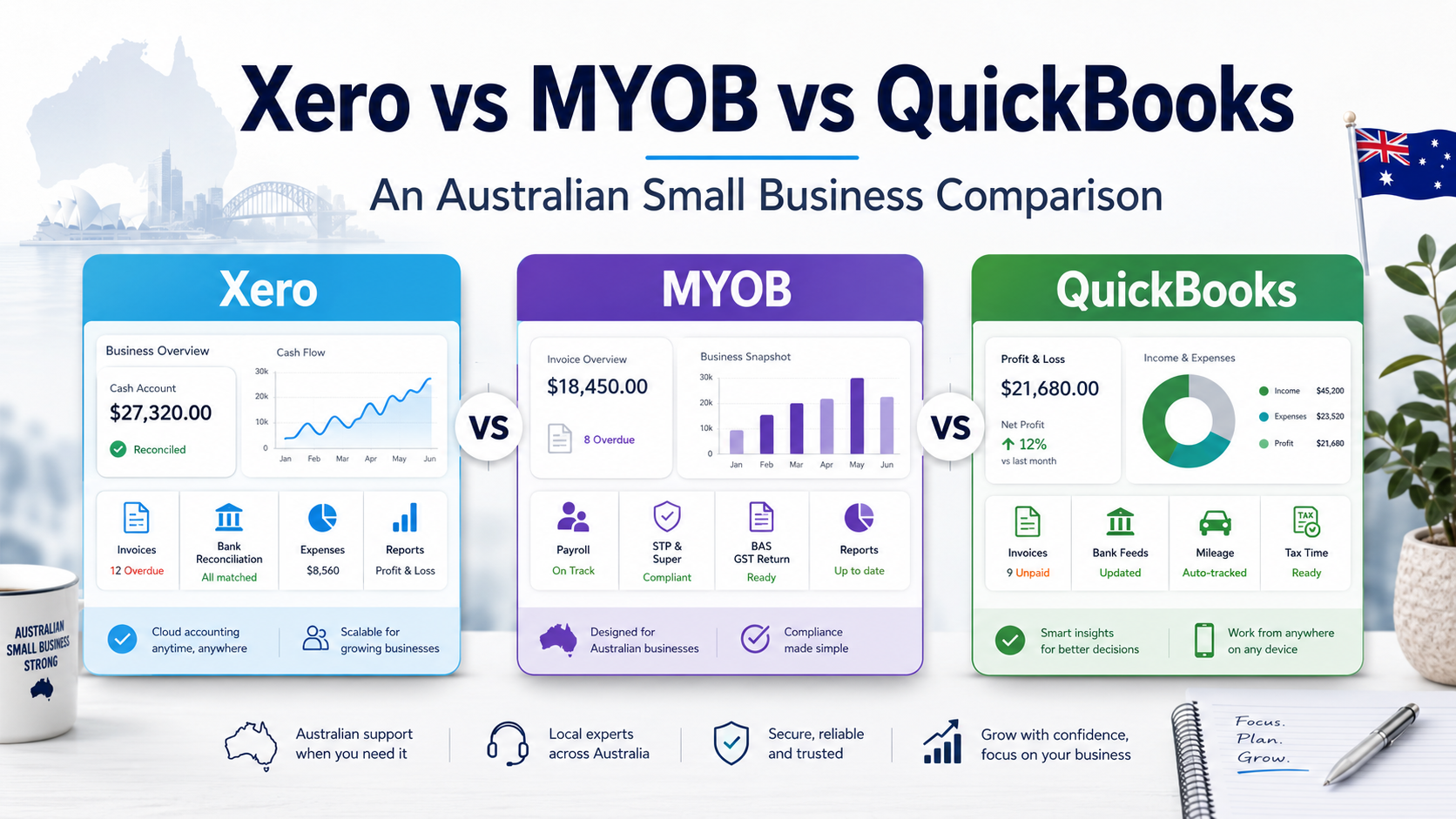
Xero vs MYOB vs QuickBooks: An Australian Small Business Comparison

Finmark Solutions
If you've spent any time researching accounting software, you've probably noticed that most comparison articles reach the same vague conclusion: "it depends on your needs." That's not helpful. Every decision depends on your needs. The job of a good comparison is to help you figure out which needs map to which platform.
This article does that. It covers the three main accounting platforms available to Australian small businesses — Xero, MYOB, and QuickBooks — with a clear-eyed look at where each one wins, where each one falls short, and which type of business should actually be using each one.
If you're genuinely in a hurry: Choose Xero. It's the right call for the majority of Australian small businesses, and the rest of this article exists to help you understand why — and to cover the genuine exceptions.
Why This Comparison Matters
The accounting software market in Australia has three dominant players, but they're not interchangeable. They were built with different assumptions about who their users are, what compliance requirements they face, and how sophisticated their accountants are.
Xero was built in New Zealand, launched in Australia early, and has Australian compliance as a core product requirement rather than an afterthought. MYOB was built in Australia and has been the local incumbent for decades. QuickBooks was built in the United States and has been adapted — with varying degrees of success — for the Australian market.
Those origins have lasting consequences for which platform does what well.
Xero: Built for the Modern Australian Small Business
The case for Xero
Xero's biggest strength isn't any single feature — it's the overall experience of running your finances through the platform day to day. The interface is genuinely clean. The bank reconciliation is fast. The integration ecosystem is unmatched. And the network of Xero-certified accountants and bookkeepers in Australia means that finding support, switching advisors, or getting advisory work done is straightforward.
For a business owner who didn't study accounting and doesn't want to, Xero is the least intimidating option. The dashboard shows you what you need to act on: invoices to approve, bills coming due, bank transactions to categorise. It doesn't bury the important stuff under twelve sub-menus.
Bank feeds and reconciliation: Xero's direct bank feeds cover all major Australian banks (CommBank, NAB, ANZ, Westpac, Macquarie, and most others), credit cards, and many smaller institutions. The feed quality is reliable, and the matching algorithm learns your patterns over time. A business with 100–200 transactions a month can typically clear its reconciliation queue in under 30 minutes once the system is set up properly.
Australian compliance: BAS, GST, STP payroll, and TPAR (Taxable Payments Annual Report for relevant industries) are all handled natively. The BAS preparation screen is one of the cleaner implementations in the market — you review your figures, check for anomalies, and hand the output to your BAS agent or lodge through the ATO portal. No spreadsheet exports required.
The app ecosystem: Over 1,000 third-party integrations. This is the most compelling practical advantage Xero has over MYOB. Whatever tools your business uses — job management, POS, CRM, time tracking, inventory, e-commerce — there's almost certainly a Xero integration available. This matters because the whole point of cloud accounting is that your data flows automatically; manual re-entry between systems defeats the purpose.
Where Xero is weaker
Complex payroll: Xero Payroll handles standard payroll scenarios competently — STP, super, leave, termination — but it can struggle with businesses running multiple complex awards, custom EBAs, or large casual workforces with variable rostering. This isn't a dealbreaker for most small businesses, but it's a real limitation for hospitality, aged care, or construction businesses with 15+ employees.
Reporting depth out of the box: Xero's standard reports are functional but not extensive. Businesses needing sophisticated financial reporting — consolidated multi-entity reports, custom KPI dashboards, job-level P&L — typically need to add a tool like Syft Analytics, Fathom, or Figured. This adds cost, though those tools are excellent.
Customer support: Xero doesn't offer phone support. Everything is handled through their online support portal, chat, and email. For most issues, this is fine. For urgent problems on a payroll run or BAS deadline, it can be frustrating.
Xero pricing (Australia, 2026)
| Plan | Price/month | Best for |
|---|---|---|
| Ignite | ~$35 | Sole traders, freelancers (20 invoice/bill limit) |
| Grow | ~$70 | Small businesses, up to 5 payroll employees |
| Comprehensive | ~$90 | Businesses needing multi-currency, expenses, projects |
MYOB: The Australian Incumbent
The case for MYOB
MYOB has been Australia's bookkeeping workhorse since the 1990s. It's deeply embedded in the market, and there are categories of business where it genuinely outperforms Xero.
Payroll for larger or more complex small businesses. MYOB AccountRight's payroll engine is more capable than Xero's for businesses with complex award structures. If you're in hospitality with 20 casuals on different penalty rates, or in construction with subcontractors and complex retentions, MYOB's payroll handles the nuance better. MYOB also has a dedicated payroll product (MYOB TeamMaster, formerly Roubler) for businesses where payroll complexity is the primary driver.
Already embedded users. If your business has been on MYOB for years, has years of historical data in the system, and your accountant knows it inside out — the switching cost (time, money, migration risk) may not be justified. There's no virtue in switching software for its own sake.
MYOB Advanced for growing businesses. Once a business is approaching $5–10M in revenue with multi-entity structures, complex inventory, or sophisticated job costing requirements, MYOB Advanced (their cloud ERP product) is a serious contender that competes with mid-market ERP systems like NetSuite and MYOB Acumatica. This is beyond most small businesses, but it's a real growth path for those who stay within the MYOB ecosystem.
Desktop option still available. MYOB AccountRight still offers a desktop version for businesses that prefer on-premise software or have limited internet connectivity. Xero and QuickBooks are cloud-only.
Where MYOB falls short
User experience: MYOB Essentials (their cloud product for small business) has improved, but it still lags behind Xero in interface quality. The navigation is less intuitive, the reconciliation workflow requires more steps, and the general experience of using it day-to-day is more effortful. For business owners doing their own bookkeeping, this friction is real.
The app ecosystem: Around 200 integrations versus Xero's 1,000+. This matters significantly if your business relies on industry-specific tools. Many job management, POS, and inventory platforms offer Xero integration but not MYOB. If you're building a connected stack, check your critical integrations before committing to MYOB.
Accountant availability: MYOB has a strong accountant network, but Xero has overtaken it in terms of how many Australian accounting firms primarily service their clients through Xero. If you're shopping for a new accountant, you'll have more options if you're on Xero.
MYOB pricing (Australia, 2026)
| Plan | Price/month | Best for |
|---|---|---|
| MYOB Essentials | ~$30 | Small businesses, basic requirements |
| MYOB AccountRight | ~$65+ | Businesses needing more capability, some desktop features |
| MYOB Business Pro | ~$60 | Mid-range cloud option with payroll |
MYOB pricing is more complex and variable than Xero's — worth checking directly for current pricing and promotional rates.
QuickBooks Online: The Global Player
The case for QuickBooks
QuickBooks Online, made by Intuit, is the world's most used small business accounting software. In Australia, its market share is much smaller than in the US or UK, but there are genuine use cases where it's the right choice.
Multi-national businesses with a US connection. If your business is an Australian subsidiary of a US entity, or if you have significant US operations alongside your Australian entity, QuickBooks' global reporting and Intuit's US ecosystem make it sensible. Consolidating reports across a US parent and Australian subsidiary is more straightforward when both are in QBO.
Businesses whose accountant specialises in QuickBooks. Uncommon in Australia, but it exists — particularly for practices that serve US-owned Australian businesses or that have a niche in cross-border tax advisory.
Specific integration requirements. QuickBooks has around 700 integrations in Australia, which is fewer than Xero but more than MYOB. For some specific software combinations, QBO may be the only option that connects all the pieces.
Where QuickBooks falls short in Australia
It was built for the US. This isn't a minor caveat — it's a fundamental structural reality. GST handling, BAS preparation, and STP payroll in QuickBooks Online Australia work, but they're adaptations of US-first features. The workflow is less polished than Xero's, and edge cases in Australian tax compliance are more likely to require manual workarounds.
Intuit's Australian investment has been inconsistent. Features that have been in the US version of QuickBooks for years have been slow to arrive in the Australian product. The local development and support resources are smaller than what Xero or MYOB invest in the Australian market.
Smaller local accountant network. The QuickBooks-certified accountant community in Australia is significantly smaller than Xero's. Finding a bookkeeper or accountant who works primarily in QuickBooks for Australian compliance takes more effort.
Pricing for Australian users. QuickBooks Online pricing in Australia has historically been less competitive than Xero's for equivalent features, and the promotional pricing is less consistent.
QuickBooks pricing (Australia, 2026)
| Plan | Price/month | Best for |
|---|---|---|
| Simple Start | ~$30 | Sole traders, very basic requirements |
| Essentials | ~$55 | Small businesses with basic payroll |
| Plus | ~$85 | Inventory, project tracking, more users |
The Full Comparison
| Criteria | Xero | MYOB | QuickBooks |
|---|---|---|---|
| Built for Australian compliance | Native | Native | Adapted |
| Ease of use | ⭐⭐⭐⭐⭐ | ⭐⭐⭐ | ⭐⭐⭐ |
| Bank feed quality | ⭐⭐⭐⭐⭐ | ⭐⭐⭐⭐ | ⭐⭐⭐ |
| BAS/GST workflow | ⭐⭐⭐⭐⭐ | ⭐⭐⭐⭐ | ⭐⭐⭐ |
| STP payroll (basic) | ⭐⭐⭐⭐ | ⭐⭐⭐⭐⭐ | ⭐⭐⭐⭐ |
| Complex payroll (15+ employees) | ⭐⭐⭐ | ⭐⭐⭐⭐⭐ | ⭐⭐⭐ |
| App integrations | ⭐⭐⭐⭐⭐ (1,000+) | ⭐⭐⭐ (~200) | ⭐⭐⭐⭐ (~700) |
| AU accountant network | ⭐⭐⭐⭐⭐ | ⭐⭐⭐⭐ | ⭐⭐ |
| Mobile app | ⭐⭐⭐⭐⭐ | ⭐⭐⭐ | ⭐⭐⭐⭐ |
| Reporting (native) | ⭐⭐⭐⭐ | ⭐⭐⭐⭐ | ⭐⭐⭐⭐ |
| Multi-currency | ⭐⭐⭐⭐ | ⭐⭐⭐⭐ | ⭐⭐⭐⭐ |
| Starting price (AUD/month) | ~$35 | ~$30 | ~$30 |
| Desktop option | No | Yes | No |
| Phone support | No | Yes | No |
Decision Framework: Which Should You Choose?
Go with Xero if you:
- Are starting a new business and choosing from scratch
- Are a sole trader, freelancer, consultant, or professional services provider
- Run a small team (under 15 employees) with standard payroll needs
- Use or plan to use industry-specific software and need integration flexibility
- Want your accountant to be able to easily work in your platform
- Value a clean interface that doesn't require accounting training to navigate
Go with MYOB if you:
- Are already using MYOB and it's working without major frustration
- Run a business with 15+ employees and complex payroll (multi-award, EBA, large casual workforce)
- Have an accountant who specifically recommends and supports MYOB
- Are considering scaling toward mid-market and want a path to MYOB Advanced
- Need desktop software due to connectivity or preference
Go with QuickBooks if you:
- Are an Australian subsidiary of a US company already using QuickBooks globally
- Have a specific integration requirement that only QBO satisfies
- Are working with an accountant who specialises in cross-border US/Australian tax
Common Scenarios — Concrete Recommendations
"I'm a freelance graphic designer and I just need to send invoices and lodge BAS."
Xero Ignite (~$35/month). It handles exactly this use case with minimal complexity. Wave is a free alternative worth considering, but its Australian compliance support is limited.
"I run a café with 12 casual staff and variable rosters."
This is a genuinely hard call. Xero's payroll handles the basics, but 12 casuals with hospitality penalty rates starts to push its limits. Xero + a dedicated rostering tool like Deputy (which integrates with both) is probably better than MYOB for most café operators, but if your accountant has strong MYOB payroll experience, MYOB AccountRight is worth a conversation.
"I'm a building contractor with 6 employees and 30+ active jobs."
Xero + Tradify or Xero + simPRO. The job management integration is what makes this work — your quotes, job costs, invoicing, and time tracking all flow into Xero automatically. MYOB doesn't have the integration depth to compete here for most trade businesses.
"I inherited MYOB when I bought this business. Should I switch to Xero?"
Not automatically. Assess: Is your accountant on Xero or MYOB? How clean is your MYOB data? Do you have specific integrations that require one platform? If the data is clean, your accountant is flexible, and there are no blockers — yes, migrating to Xero will probably make your day-to-day bookkeeping easier. But do it at a logical transition point (financial year end, for example) and get help with the migration.
"My US parent company uses QuickBooks and I need to consolidate reporting."
QuickBooks Online Australia. Consolidating across entities is easier within one platform. Check that the specific features you need (multi-currency reporting, consolidated P&L) are available in the Australian product before committing.
Frequently Asked Questions
Is Xero the most popular accounting software in Australia?
By market share among small businesses and accounting practices, Xero has become the dominant cloud accounting platform in Australia. It has overtaken MYOB in most segments, though MYOB retains strong share in businesses with complex payroll and longer-standing enterprise relationships.
Can I use QuickBooks in Australia for GST and BAS?
Yes — QuickBooks Online Australia includes GST tax codes and a BAS preparation feature. The workflow is functional but less polished than Xero's BAS tools. It works, but it typically requires more manual review and occasional workarounds for edge cases in Australian tax compliance.
What is the cheapest accounting software for small business in Australia?
For paid software, MYOB Essentials and QuickBooks Simple Start both start around $30/month. Xero starts at approximately $35/month. Wave offers a free tier, but with limited Australian compliance features. For most small businesses, the difference in cost between these platforms is negligible compared to the time cost of using less capable software.
Is MYOB better than Xero for payroll?
For businesses with complex payroll requirements — multiple awards, large casual workforces, EBAs — MYOB AccountRight's payroll engine is more capable than Xero's standard payroll module. For straightforward payroll (salaried staff, standard casual rates, under 10 employees), Xero handles it well. The payroll complexity threshold where MYOB becomes preferable is roughly 15+ employees with non-standard structures.
How long does it take to switch from MYOB to Xero?
A clean migration for a small business typically takes 2–4 weeks when working with a migration specialist or Xero-certified accountant. This includes setting up the chart of accounts, migrating contacts and opening balances, connecting bank feeds, and testing reconciliation. Historical transaction data from MYOB is generally kept in MYOB (archived) rather than migrated, with a clean start date in Xero.
The Bottom Line
Xero is the best accounting software for most Australian small businesses in 2026. It's easier to use, better integrated, more widely supported by local accountants, and built with Australian compliance requirements as a core design principle rather than an add-on.
MYOB remains the right choice for businesses with complex payroll, those already invested in the platform, or those growing toward mid-market complexity. QuickBooks Online serves a specific niche — primarily businesses with US connections or global reporting requirements.
If you're starting from scratch, start with Xero. The free trial removes any risk from making that call.
Try Xero free for 30 days →
Related reading:
- Best Accounting Software for Small Business in Australia
- Best Accounting Software for Sole Traders in Australia
- Best Cloud Accounting Software for Small Business
- Best Accounting Software for Construction and Trade Businesses