---
title: Strategic Planning Guide for Small Business
description: Strategic planning guide for small business - basic enough to be able to follow, comprehensive enough to ensure you've got most bases covered. Download our templates today.
image: https://www.finmarksolutions.com.au/hubfs/Business%20person%20looking%20at%20road%20with%20question%20mark%20sign%20concept.jpeg
---
[Skip to content](https://www.finmarksolutions.com.au/strategic-planning-guide-for-small-business#main-content)
[Homepage](https://www.finmarksolutions.com.au/?hsLang=en-au)
- [Home](https://www.finmarksolutions.com.au?hsLang=en-au)
- [Software Recommendations](https://www.finmarksolutions.com.au/finmark-business-software-directory?hsLang=en-au)
- [How-To Guides](https://www.finmarksolutions.com.au/how-to-guides?hsLang=en-au)
- [Tools](https://www.finmarksolutions.com.au/tools?hsLang=en-au)
- [Blog](https://www.finmarksolutions.com.au/blog?hsLang=en-au)
- [About](https://www.finmarksolutions.com.au/author-bio?hsLang=en-au)
- [Home](https://www.finmarksolutions.com.au?hsLang=en-au)
- [Software Recommendations](https://www.finmarksolutions.com.au/finmark-business-software-directory?hsLang=en-au)
- [How-To Guides](https://www.finmarksolutions.com.au/how-to-guides?hsLang=en-au)
- [Tools](https://www.finmarksolutions.com.au/tools?hsLang=en-au)
- [Blog](https://www.finmarksolutions.com.au/blog?hsLang=en-au)
- [About](https://www.finmarksolutions.com.au/author-bio?hsLang=en-au)
> *What I wish I'd known when starting — so you don't have to figure it out the hard way. 13+ years of business systems, digital marketing, and strategy for project & service businesses, shared.*
## Strategic Planning Guide for Small Business
### The case for strategic planning
When most small businesses hear "strategic planning" it sounds terribly boring! Especially if the benefits haven't been experienced yet. Let me present the case for strategic planning.
Suppose you set out on a road trip but you didn't quite know the destination. Or perhaps you think it might be one of 3 towns that you're thinking of but they're all 3 hrs apart, so the two furthest apart are 9 hrs away from each other, but you have the chance to set the GPS at the start of the journey. If you set the GPS for the wrong one, and only find out when you get there, you've got another 9 hours of driving to go and you probably won't get there the same day, you'll waste fuel getting there, and you've probably missed the key customer appointment that you meant to get to which might cost you a lot of potential income.
This is strategic planning - it is setting the GPS at the start so you don't waste fuel and time and opportunity. This might seem blindingly obvious to anyone who is used to driving, but it's surprisingly common that businesses make this mistake in their business activities - wasting fuel, time, opportunity, because of lack of direction. On the other side, do it right and you outstrip your competitors because you have got a clear goal and efficiently driving towards it.
However strategy isn't set once - it's constantly refreshed. Why, you ask? Because once you get to the next town you might realise there's more customers you didn't know about in another town that you now need to visit, and you didn't know that at the beginning of the journey. So you set the GPS and off you go to the next spot.
Welcome to the world of strategy!
Step-by-Step below is a guide to setting your strategy.
For the templates that help you actually get these done, click here:
1. Diagnosis document (finding where you are now): [#1 Where are we now document (analysis).docx](https://1drv.ms/w/c/859097d9bb1d3451/IQCduL_4-fYnQby6SOAtnmhNAVVoZR1wjEruBlg9SGyx9iQ?e=F02IQK)
2. Finmark One page plan template - [#2 SOAP strategic plan.docx](https://1drv.ms/w/c/859097d9bb1d3451/IQBwNlzuzoP5Srw0BRosVVNyAfwY6fpkDf7EIbc-v9el438?e=XlWq6d)
Keep in mind - these templates are just thought-starters and something to help kickoff. Ideally you take these and develop into your own formats, or use some sort of a proprietary platform like EOS (ninety.io or Bloom tools) or Scaling up "align software" plus a coach or a dedicated in-house person who is determined to follow it up, to keep it accountable and execute on.
#1 - Where are we now?
This is a very important starting block. If you don't know where you are, it's very hard to set the GPS correctly to get to where you want to be!
Questions to ask:
1. What's our business's cashflow position and forecast?
- Why is this important? Because you can live for a long time without profits but the business dies the day that you run out of cash. This is Absolutely #1 and must remain number #1 forever for your business - never ever run out of cash.
2. What's our business equity? (Assets minus liabilities, or simply, what you own minus what you owe). Otherwise known as net worth
- Why this is important? Because your equity position largely determines your options - can you afford to invest or are you bootstrapping this business right now?
3. Customer feedback - what are customers saying?
- Why is this important? Because customer's direct comments - their own words, are very powerful, and usually contain the gold nuggets that you need to find how to satisfy them and obtain more good customers
4. Staff feedback - what's the staff position?
- Why is this important? Because your staff are the face of your business - they will be representing you to your customer, and you need to ensure that they're aligned with the direction of the business and happy so they can present that happy face to the customer and sell them on your product or service. The old adage "everyone is in sales" applies here - your delivery drivers are often your best salespeople as they're dropping off goods and shaking the hands and can spot opportunity and impress the customer.
5. Supplier feedback - what feedback do we have from suppliers?
- Why is this important? Because the suppliers of your business are the critical link that allows you to service your customers - without them, you can't deliver the product. While you want to get the best deals, ensure that you have happy suppliers so you don't risk your supply chain.
6. Org chart - what's our current org chart and does it match where we need to go?
- Why is this important? Because the right people in the right seats is a very powerful thing when it's right, and catastrophic when it's not. If you've got someone who's very good at reading maps, and someone who's very good at driving, ensure that the map reader is on the maps and the driver is behind the wheel. Basic, but essential. Also think through the functions of the business - don't just have people for the sake of people, they are there only to ensure that you can deliver for the customer, not to perform superfluous activities. Ensure there's "one throat to choke" per each main department of the 5 key areas of business - Marketing, Sales, Operations, Finance, and Admin/mgmt.
7. What's our revenue drivers or transaction levels?
1. Why is this important? Because it determines what resource and systems you need. For example, are you a product business with thousands of SKU's performing 50 shipments a day, or are you a project based business delivering 60 projects a year or are you a service business performing maintenance contracts, or an accounting company servicing 100 clients?
2. Review number of transactions (either sales signed or invoices out, depending on your model), average invoice/account value
3. What % of Gross Profit comes from the top 10 customers (the 80/20 rule applies here - usually there's the critical few that contain the mass of your Gross Profit)
4. Review Revenue by product group
5. Review GP % by product group - this can surprise you as sometimes the revenue per product and the GP per product can be very different - often your most profitable items are hiding inside a category that doesn't show much at the revenue level but is pulling hard behind the scenes.
8. Where are we on the Ansoff matrix?
- The Ansoff Matrix is a very interesting tool that highlights are you developing a strategy of diversification, or deeper existing market/product penetration, or a mix of both? This is key because new markets or products are always harder to get going than existing markets or products, because of the law of momentum - if you can sell more of your existing products to existing markets, then that's the easiest, the other methods are a bit harder.
- 
9. Perform a SWOTT analysis
- An extension of the SWOT tool - This is "Strengths, Weaknesses, Opportunities, Threats, and Trends".
- This is a very helpful tool to fill in, as long as you know what to do with it.
- Strengths: Capitalize on them, play to your strengths, emphasise them, market them, show them to customers if it's something that differentiates you
- Weaknesses: Acknowledge them, open your eyes to them, then figure are you comfortable with them remaining weaknesses, or do you need to develop a strategy to fix those weaknesses? Add to your plan accordingly
- Opportunities: "Carpe Diem" - seize the day! Opportunities in the market don't last forever, grab hold of them
- Threats - these are something that could range from small business to a complete threat to the business'sses existence. Take them seriously and develop mitigation strategies for each one.
- Trends - the last part of the "SWOTT" and one popularized in recent years because it opens the eyes to emerging forces that are changing the market, rather than just simply focusing on 'what is' - this can be anything from wars to AI to COVID, these all have shaped things. For example, COVID drove the most rapid explosion in video calls as a method of doing business or teamwork in history - Zoom grew from around $330 million revenue in 2019 to $4 Billion by 2022. That's market-changing stuff, and opens possibilities such as, can your sales team use it more to prevent the need for travel for example?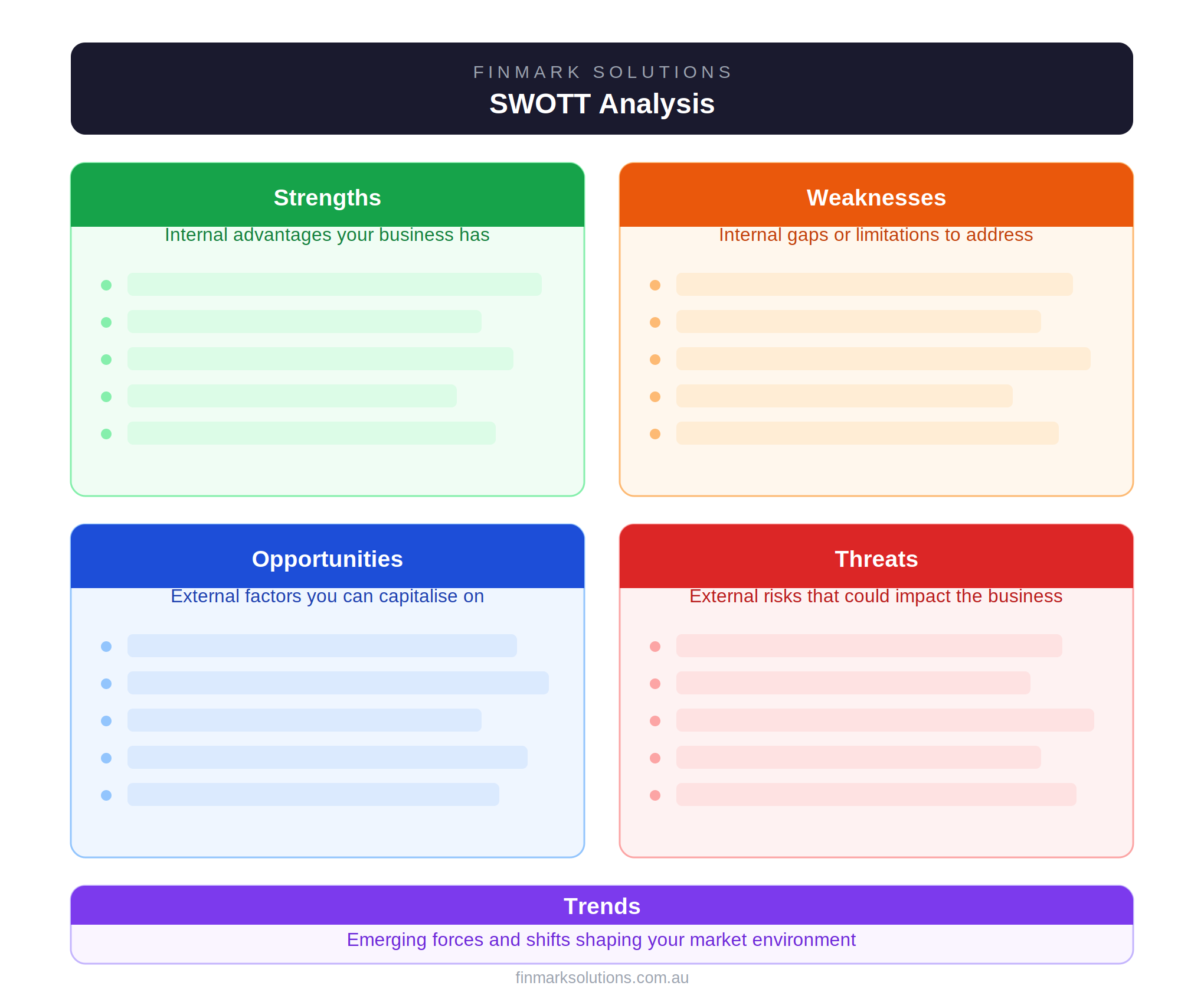
10. List out any issues that are top of mind - no matter what they are or what category - just list the issues. Then beside it in another column, put the rating of how important it is - with a scale of "small, doesn't matter" to "Business critical - if we don't fix it'll fail"
- Why is this important? Because often there are glaring issues in the business that once identified, can form a core part of your strategy to fix up and improve on, and can end up being a point of difference even.
1.
#2 - Where do we want to be?
This is the future-planning, the exciting part. The setting of the GPS for your future location.
Remember when setting goals, the "S.M.A.R.T" Acronym:
Specific - When you describe it to someone, do they know exactly what you're aiming at or is it just a bit unclear?
Measurable - Can you measure it in numbers or quantify it?
Achievable - Do you have the resources, skills, and capacity to pull this off?
Relevant - Should you even be doing this? Is it relevant to your end goal? Is it relevant to your broader objectives, or just busy work?
Time-bound - There is a clear end date to when you must have achieved this, not open-ended.
An example of a SMART goal in the same logic as the car trip: We will drive from the Melbourne Cricket ground to Bondi Beach in Sydney (specific), it is exactly 875km to drive (measurable), We have two drivers so we can manage it (Achievable), We are doing this for a family holiday that the entire family agreed on (Relevant), and the trip will take 9hrs 12 mins plus 1hr of stops, so we will leave early in the morning at 6am and arrive at 4:12pm in the afternoon (Time-bound).
1. Do you have a BHAG (Jim Collins concept of "Big Hairy Audacious Goal") or your 10-year Goal in other words?
- This can be a helpful guiding principle - for example if you envision a massive company or just a steady ticking business, these two are worlds apart in terms of what you need to plan for in terms of physical locations, legal, financial, HR, etc.
- If you do have one, then put forward what that might look like in writing. Ideally this has numbers attached to it rather than just a vision.
2. What is your 3-year goal?
- This is a more "bite-sized chunk" than a 10-year goal, and in fact is quite permissible to only have this if you don't want to have a BHAG. It's a lot easier to think about. Again, ideally this has numbers attached to it, not just a vision, and if you have a BHAG, should support achieving the BHAG (i.e if you achieve this, you're on the way to the BHAG or 10 year goal being achieved)
3. What is your 1-year goal, or the main objective of the next 12 months?
- This is your primary target that all other activities or actions will drive towards for the next 12 months. This is usually a monetary goal (x $ net profit for example) or something similar, since most business goals revolve around ROI.
4. What key projects or supporting goals will help achieve this main goal?
- Suggest maximum of 3-4 for this, to not overwhelm. For example you might need to move premises, or setup a digital marketing campaign to drive inbound, or hire new technical staff to support your delivery, or hire new sales staff, or upgrade the fleet, or perhaps run a lean initiative to slim down the overheads to achieve the net profit you need.
5. What key metrics will ensure we're on track for this main goal?
- As a minimum, suggest a minimum of one "lead" and one "lag" measure per department.
- A "Lead measure" is one that predicts future outcomes, and can be influenced, like looking out the drivers windscreen. For example, this might be sales calls done, or quotes.
- A "Lag measure" is one that shows whether the outcome was achieved and by then it's too late to do anything about it (rear-view mirror). This might be sales signed $$ or ##.
- Decide how to dashboard these - i.e. inside a CRM, on a whiteboard manually, or on an email etc.
- Departments to consider setting these for:
- Marketing (driving top-of-funnel)
- Sales (turning that funnel into real $$)
- Operations (how much it's producing of the promised sales)
- Finance (reporting deadlines)
- Business-wide: Ensure break-even is met (i.e. ensure money coming in is greater than money out each month)
6. Put all the above onto a single document or ideally single page
- Many acronyms and templates exist for this - can search online for these. Such as SOAP or OPSP etc.
#3 - Execute the plan
This is where the rubber meets the road - and is the hardest part of the whole lot.
The 4 disciplines of Execution by the Covey foundation capture it pretty well - they say:
1. Focus on the wildly important (i.e. keep the main goal top of mind)
2. Act on lead measures (i.e. focus on the things you can control, the windscreen ahead, not just the lag measures)
3. Keep a compelling scoreboard (make the lead and lag measures visible)
4. Keep a cadence of accountability (weekly meetings) to keep it on track
As simple as these concepts are, they are very hard to keep onto.
The cadence of accountability is probably the hardest of the lot - keeping it consistently checked in, reported, and managed. Have a key person responsible for the plan who is dedicated to ensuring those team meetings happen and the plan stays on track - use outlook / google calendar to book teams meetings or zoom meetings or whatever is needed, but keep it accountable.
For the templates that help you actually get these done, click here:
1. Diagnosis document (finding where you are now): [#1 Where are we now document (analysis).docx](https://1drv.ms/w/c/859097d9bb1d3451/IQCduL_4-fYnQby6SOAtnmhNAVVoZR1wjEruBlg9SGyx9iQ?e=F02IQK)
2. Finmark One page plan template - [#2 SOAP strategic plan.docx](https://1drv.ms/w/c/859097d9bb1d3451/IQBwNlzuzoP5Srw0BRosVVNyAfwY6fpkDf7EIbc-v9el438?e=XlWq6d)
Keep in mind - these templates are just thought-starters and something to help kickoff. Ideally you take these and develop into your own formats, or use some sort of a proprietary platform like EOS (ninety.io or Bloom tools) or Scaling up "align software" plus a coach or a dedicated in-house person who is determined to follow it up, to keep it accountable and execute on.
[](http:/?hsLang=en-au)
- [Home](https://www.finmarksolutions.com.au?hsLang=en-au)
- [Software Recommendations](https://www.finmarksolutions.com.au/finmark-business-software-directory?hsLang=en-au)
- [How-To Guides](https://www.finmarksolutions.com.au/how-to-guides?hsLang=en-au)
- [Tools](https://www.finmarksolutions.com.au/tools?hsLang=en-au)
- [Blog](https://www.finmarksolutions.com.au/blog?hsLang=en-au)
- [About](https://www.finmarksolutions.com.au/author-bio?hsLang=en-au)
---
[Privacy Policy](https://www.finmarksolutions.com.au/privacy-policy?hsLang=en-au) · © 2026 Finmark Solutions. All rights reserved.
Content on this site is for informational purposes only and does not constitute financial, legal, or professional advice. Always consult a qualified professional before making business or financial decisions.
Some links on this website may be affiliate links. Finmark Solutions may earn a commission if you purchase through those links, at no extra cost to you. [Affiliate Disclosure](https://www.finmarksolutions.com.au/affiliate-disclosure?hsLang=en-au)