---
title: "Fire Bullets, Then Cannonballs: How to Use Google Ads to Find Where to Aim Your Big Guns"
description: Most businesses guess which keywords are worth ranking for — then spend thousands on SEO to find out they guessed wrong. Here's how to use a small Google Ads budget to prove what converts before you invest the big dollars.
image: https://www.finmarksolutions.com.au/hubfs/Bullets%20then%20cannonballs.png
---
[Skip to content](https://www.finmarksolutions.com.au/blog/fire-bullets-then-cannonballs-how-to-use-google-ads-to-find-where-to-aim-your-big-guns#main-content)
[Homepage](https://www.finmarksolutions.com.au/)
- [Home](https://www.finmarksolutions.com.au)
- [Software Recommendations](https://www.finmarksolutions.com.au/finmark-business-software-directory)
- [How-To Guides](https://www.finmarksolutions.com.au/how-to-guides)
- [Tools](https://www.finmarksolutions.com.au/tools)
- [Blog](https://www.finmarksolutions.com.au/blog)
- [About](https://www.finmarksolutions.com.au/author-bio)
- [Home](https://www.finmarksolutions.com.au)
- [Software Recommendations](https://www.finmarksolutions.com.au/finmark-business-software-directory)
- [How-To Guides](https://www.finmarksolutions.com.au/how-to-guides)
- [Tools](https://www.finmarksolutions.com.au/tools)
- [Blog](https://www.finmarksolutions.com.au/blog)
- [About](https://www.finmarksolutions.com.au/author-bio)
> *What I wish I'd known when starting — so you don't have to figure it out the hard way. 13+ years of business systems, digital marketing, and strategy for project & service businesses, shared.*
# Fire Bullets, Then Cannonballs: How to Use Google Ads to Find Where to Aim Your Big Guns

Finmark Solutions
May 14, 2026
*Why the smartest businesses spend a few hundred dollars on ads before spending thousands on SEO*
---
Most small business owners approach digital marketing in the wrong order.
They either start with SEO — spending $1,500–$3,000/month with an agency for six to twelve months before seeing meaningful results — or they skip it entirely and burn money on Google Ads without knowing what they're actually trying to achieve.
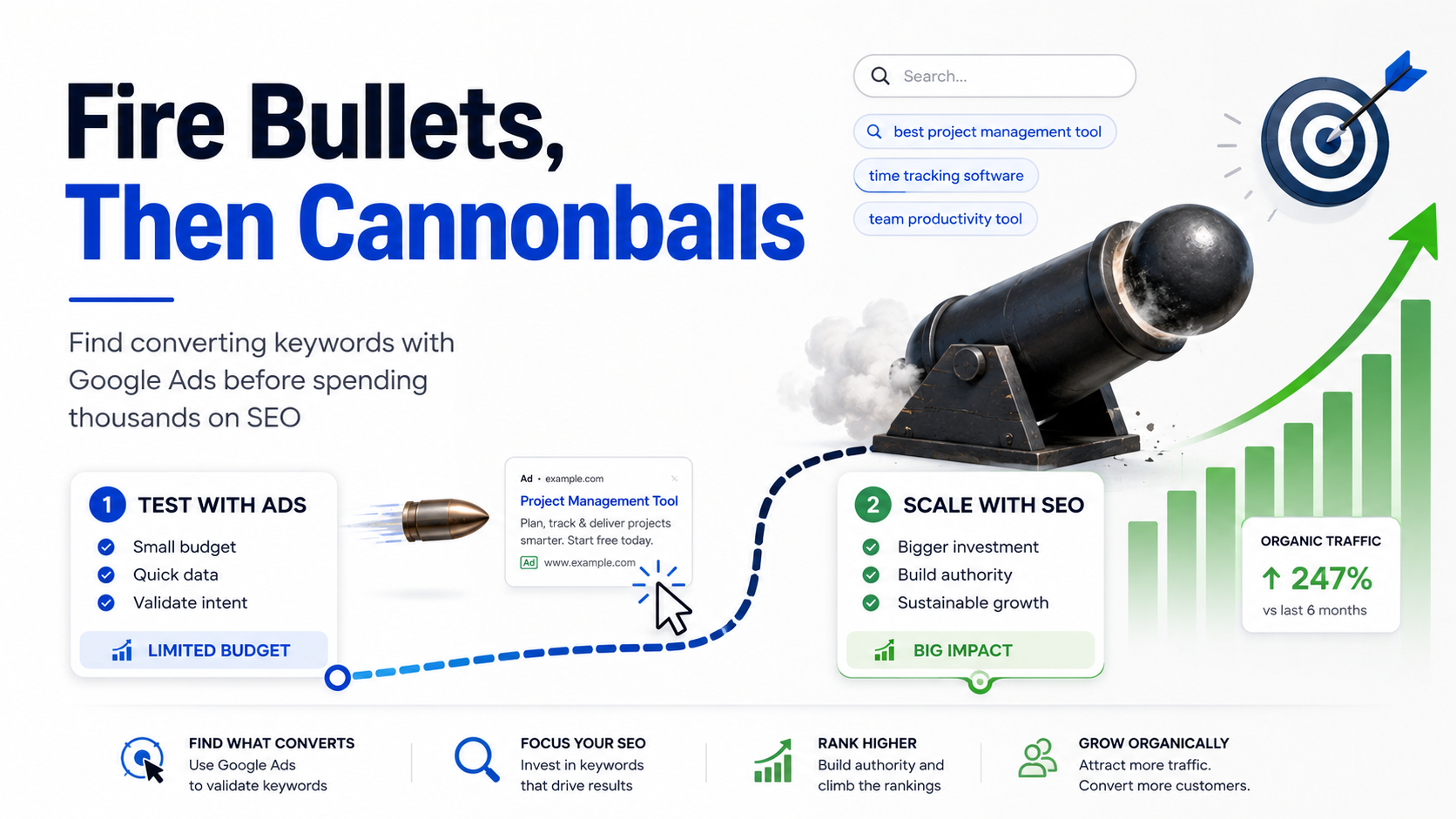
There's a smarter sequence. It comes from a concept Jim Collins introduced in *Great by Choice*: fire bullets first, then cannonballs.
The idea is simple. Before you commit significant resources to a direction, fire cheap, low-risk test shots to find out what actually hits the target. Once you've confirmed something works, *then* you load the cannonball and fire with full force.
Applied to digital marketing, it looks like this:
> **Spend a few hundred to a few thousand dollars on Google Ads to find which keywords actually convert — then invest your serious SEO budget optimising for exactly those terms.**
Instead of guessing which keywords are worth ranking for, you *buy* the data. Then you use it.

---
## Why This Works: The Core Logic
SEO is a long game. It typically takes 6–18 months to rank for competitive terms, and the bill runs regardless of whether those rankings eventually produce customers. You're making a large, slow, expensive bet on keywords you *think* will convert.
Google Ads gives you the same data in 2–4 weeks.
When someone clicks your ad and books a job, you know three things with certainty:
1. The exact search term they used
2. That the term has real commercial intent
3. That your offer can convert that traffic
That's not a hypothesis. That's proof. And proof is exactly what you want before you commit $15,000–$40,000 to an SEO campaign.
---
## The Method, Step by Step
### Step 1: Set Up Tracking Before You Spend a Dollar
This is non-negotiable. Without conversion tracking, you're just watching money leave your account.
Set up:
- **Google Analytics 4** on your website
- **Google Ads conversion tracking** — specifically tracking phone calls (calls from ads + calls from your website) and form submissions
- **Google Tag Manager** to manage it all cleanly
If someone calls you from an ad, you need to know which keyword triggered that call. If they fill out a contact form, same thing. Without this, the whole method falls apart.
Most web developers can set this up in under an hour. Google's own support documentation walks through it step by step if you're doing it yourself.
### Step 2: Run a Deliberately Broad Search Campaign
The goal of this phase isn't to run a perfectly optimised campaign — it's to *discover*. You want to cast a reasonably wide net and see what comes back.
Build a Search campaign covering your core service categories. Use a mix of phrase match and broad match modified keywords. Set a modest daily budget — $30–$60/day is enough in most Australian local markets to gather meaningful data within 2–4 weeks.
**Example for a commercial builder:**
- "commercial construction \[city\]"
- "steel frame shed builder"
- "industrial warehouse construction"
- "fitout contractor \[city\]"
- "tilt panel construction"
You're not trying to be efficient yet. You're trying to find signal in the noise.
### Step 3: Let It Run and Watch the Search Terms Report
The Search Terms Report is the most valuable document in Google Ads for this exercise. It shows you the *actual searches* that triggered your ads — not the keywords you bid on, but the real language people typed into Google before clicking through.
Check it every few days. You'll see three types of terms come through:
**Irrelevant terms** — add these as negative keywords immediately. Don't pay for clicks you know are worthless.
**Terms that get clicks but don't convert** — interesting. Either the intent is wrong, or your landing page isn't converting them. Investigate before discarding.
**Terms that convert** — these are gold. Someone searched this exact phrase, found your ad, visited your site, and called or enquired. That's a proven commercial keyword.
Mark every converting term. These are your bullets that hit.
### Step 4: Identify Your Cannonball Keywords
After 3–6 weeks of running, you'll have a clear picture of which search terms are actually driving enquiries.
Now ask: what would it mean for my business if I ranked #1 organically for these terms — for free — forever?
That's the cannonball question.
A keyword that costs you $12 per click in Google Ads, converts at 8%, and brings in a $4,000 job is worth an enormous SEO investment to own permanently. A keyword that gets clicks but never converts isn't worth a cent of SEO spend regardless of how much traffic it generates.
Most SEO agencies will never tell you this, because their pitch is built on traffic volume. Traffic isn't revenue. Conversions are.
### Step 5: Brief Your SEO Investment Around the Data
Now you go to an SEO agency — or tackle it yourself — with a specific, proven brief:
*"These are the 5–8 keywords that have demonstrably converted into leads and customers over the past 6 weeks. I want to rank on page one for these terms in my service area. What will that take and what will it cost?"*
That's a fundamentally different conversation than: *"We're a builder, can you get us more traffic?"*
You're not buying vague optimisation. You're buying rankings for specific terms you've already proven are worth owning. Any decent SEO agency will be able to give you a realistic roadmap — and you'll be able to hold them accountable to the outcomes that actually matter.
### Step 6: Keep Ads Running in Parallel (Strategically)
Once your organic rankings start to climb — typically 3–9 months into a well-executed SEO campaign — you have options:
**For terms where you now rank #1 organically:** reduce or pause your paid spend on those terms. You're getting the traffic for free. Redirect that budget to keywords you haven't yet cracked organically.
**For high-value terms:** consider running both. Studies consistently show that appearing in both the paid and organic results for the same search increases total click-through rate significantly — the dual presence signals authority and dominates the visible page.
**For competitive terms where organic ranking is slow:** maintain paid ads as a bridge while SEO compounds in the background.
The end state you're building toward: organic rankings delivering free, high-intent traffic to your highest-converting keywords, with paid ads used tactically on top — not as your entire strategy.
---
## The Numbers: Why This Makes Financial Sense
Here's a simplified example to illustrate the logic:
**Bullets phase (Google Ads testing):**
- Budget: $1,500 over 6 weeks
- Result: 3–4 proven converting keywords identified
- Jobs generated during testing: 2–3 (often pays for itself)
**Cannonball phase (SEO investment):**
- Investment: $2,000–$4,000/month for 6–9 months with a decent agency
- Target: page 1 organic rankings for 4–5 proven keywords
- Once ranked: $0 ongoing cost per click for that traffic
**Comparison:** A keyword costing $15 CPC that drives 200 clicks/month is costing you $3,000/month in perpetuity via ads alone. Own that keyword organically and the same traffic costs nothing after the SEO investment is recouped. For most small businesses in competitive local markets, that crossover point arrives within 12–18 months.
---
## What This Isn't
This isn't an argument against Google Ads as an ongoing channel. For many businesses, Google Ads should run permanently — especially for high-margin services where the maths works and you want volume you can control.
It's also not an argument that SEO is always the right endgame. Some markets are so competitive that ranking organically for your best keywords is a multi-year, high-cost exercise. In those cases, paid search may remain the more efficient long-term channel. The bullets phase tells you that too.
What this method gives you is *information* before commitment. You spend small to learn, then spend big on what the data already told you works.
---
## The Mistake to Avoid
The most common version of this that goes wrong: businesses run Google Ads, get some leads, but never actually *analyse* the Search Terms Report to extract the converting keywords. The ads run as a lead generation channel and the data just sits there unused.
Set a calendar reminder for the end of your testing window. Pull the Search Terms Report, filter by conversions, export it, and sit down with it properly. That document is worth more than the leads you generated during the test — because it tells you where to aim everything that comes next.
---
## Summary: The Sequence
| Phase | Action | Timeline | Cost |
| --- | --- | --- | --- |
| 1. Foundation | Website + tracking + GBP | Week 1–2 | Low/free |
| 2. Bullets | Google Ads test campaign | Weeks 3–8 | $1,000–$2,500 |
| 3. Analysis | Identify converting keywords | Week 8–9 | Your time |
| 4. Cannonballs | SEO investment on proven terms | Months 3–12 | $2–4k/month |
| 5. Optimise | Reduce ads where ranked; scale what works | Ongoing | Reduces over time |
Fire enough bullets to know what hits. Then load the cannonball.
---
*If you're starting from zero and want the full free-first approach before spending anything, read our companion guide: [The Small Business Digital Marketing Playbook: Start Free, Scale Smart](https://www.finmarksolutions.com.au/blog/the-small-business-digital-marketing-playbook-start-free-scale-smart-version-for-nil-budget-startups).*
## Share this post
[mailto:https%3A%2F%2Fwww.finmarksolutions.com.au%2Fblog%2Ffire-bullets-then-cannonballs-how-to-use-google-ads-to-find-where-to-aim-your-big-guns](mailto:https%3A%2F%2Fwww.finmarksolutions.com.au%2Fblog%2Ffire-bullets-then-cannonballs-how-to-use-google-ads-to-find-where-to-aim-your-big-guns)
## Keep reading
### [The AI Tools That Actually Move the Needle in Business (And Where They Fall Short)](https://www.finmarksolutions.com.au/blog/the-ai-tools-that-actually-move-the-needle-in-business-and-where-they-fall-short)
### [Best Fee-Free Business Bank Accounts in Australia](https://www.finmarksolutions.com.au/blog/best-fee-free-business-bank-accounts-in-australia)
[](http:///)
- [Home](https://www.finmarksolutions.com.au)
- [Software Recommendations](https://www.finmarksolutions.com.au/finmark-business-software-directory)
- [How-To Guides](https://www.finmarksolutions.com.au/how-to-guides)
- [Tools](https://www.finmarksolutions.com.au/tools)
- [Blog](https://www.finmarksolutions.com.au/blog)
- [About](https://www.finmarksolutions.com.au/author-bio)
---
[Privacy Policy](https://www.finmarksolutions.com.au/privacy-policy) · © 2026 Finmark Solutions. All rights reserved.
Content on this site is for informational purposes only and does not constitute financial, legal, or professional advice. Always consult a qualified professional before making business or financial decisions.
Some links on this website may be affiliate links. Finmark Solutions may earn a commission if you purchase through those links, at no extra cost to you. [Affiliate Disclosure](https://www.finmarksolutions.com.au/affiliate-disclosure)
```json
{
"@context" : "https://schema.org",
"@type" : "BlogPosting",
"author" : {
"@type" : "Person",
"name" : "Finmark Solutions",
"url" : "https://www.finmarksolutions.com.au/blog/author/finmark-solutions"
},
"dateModified" : "2026-05-14T11:25:18.700Z",
"datePublished" : "2026-05-14T11:25:18.000Z",
"headline" : "Fire Bullets, Then Cannonballs: How to Use Google Ads to Find Where to Aim Your Big Guns",
"image" : [ "https://www.finmarksolutions.com.au/hubfs/Bullets%20then%20cannonballs.png" ],
"mainEntityOfPage" : {
"@id" : "https://www.finmarksolutions.com.au/blog/fire-bullets-then-cannonballs-how-to-use-google-ads-to-find-where-to-aim-your-big-guns",
"@type" : "WebPage"
},
"publisher" : {
"@type" : "Organization",
"logo" : {
"@type" : "ImageObject",
"url" : "https://www.finmarksolutions.com.au/hubfs/Logo_1_Vector.jpg"
},
"name" : "Finmark Solutions"
}
}
```